


Sometimes it’s not life that feels heavy — it’s the voice inside that insists on being right, staying safe, and looking strong. That quiet but persistent inner narrator that wants to win every argument, hide every mistake, and keep control at any cost. That’s not confidence speaking. That’s ego — and when it takes the driver’s seat, it subtly shapes how you see yourself, others, and the world around you.
Most of us don’t even realize when our ego begins running the show. It’s tricky, because ego doesn’t always show up as arrogance or pride. Sometimes, it hides behind perfectionism, people-pleasing, or even the fear of being misunderstood. It whispers things like, “They don’t respect you enough,” or “You should’ve done better.” And before we notice, it starts calling the shots — guiding how we respond, compete, or protect ourselves.
When ego is balanced, it helps us survive, achieve, and define our identity. But when it becomes overprotective, it turns from a guide into a guard — one that keeps us trapped inside our comfort zone. This article explores the signs your ego is in control, how it quietly directs your thoughts and choices, and how to recognize when it’s time to step back into conscious awareness. Because once you understand how ego operates, you can stop fighting it — and start transforming it.
Table of Contents
When Ego Is In Control…
When your ego is in control, it’s like viewing the world through a tinted lens. Every situation, every comment, every decision is filtered through How does this make me look? or What does this say about me? You’re not responding to life as it is — you’re reacting from the need to maintain your image, status, or superiority.
Psychologist Sigmund Freud first described the ego as the part of the mind that mediates between our primitive instincts (the id) and moral ideals (the superego). But modern psychology expands that understanding — the ego is also the “self-concept” that shapes how you see yourself in relation to others. When that self-concept becomes rigid, your thoughts and behaviors begin revolving around self-protection, rather than growth or connection.
In other words, your ego becomes your autopilot. You might find yourself defending your point even when you know you’re wrong, comparing yourself endlessly to others, or chasing achievements not because they fulfill you — but because they validate you.
A 2018 study in the journal Frontiers in Psychology found that people with a more “ego-driven orientation” tend to experience higher stress, social tension, and emotional reactivity, because they perceive more situations as personal threats to their identity.
The tricky part? Ego control doesn’t always look loud or aggressive.
It can look like silence — the kind that hides insecurity behind withdrawal or avoidance.
It can look like people-pleasing, perfectionism, or even the constant need to be “the good one.”
In every case, the same pattern unfolds: the fear of losing control overrides the freedom of being authentic.
Recognizing when your ego is steering your choices isn’t about judging yourself — it’s about becoming aware of the subtle ways it distorts reality. Because awareness is what gives you the power to choose differently.
Read more

Signs Your Ego is in Control
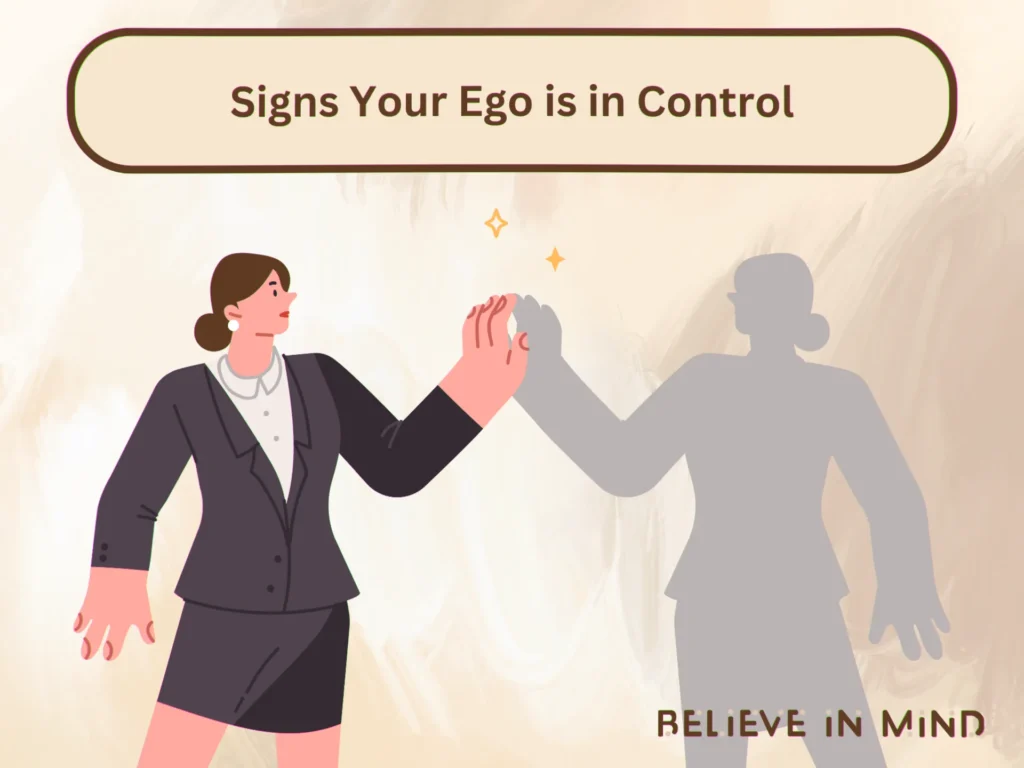
When the ego takes charge, it doesn’t shout — it whispers. It hides behind good intentions, confidence, and logic, convincing us that we’re just protecting ourselves. But in truth, it slowly begins to protect the idea of ourselves more than the self itself.
Psychologists describe the ego as the mental construct that organizes how we see ourselves in relation to the world — our roles, beliefs, and identity. When balanced, it helps us navigate life with confidence. When inflated or threatened, it bends reality to defend its own image. The signs of this shift are often subtle but deeply revealing.
1. The Need to Be Right — Even at the Cost of Connection
Defensiveness is one of the most telling indicators that the ego is quietly steering your reactions. According to Baumeister and Vohs (2001), when people experience “ego threat,” the brain activates a defensive state that prioritizes self-preservation over learning or empathy.
That’s why in arguments — whether with a partner, colleague, or friend — we often feel an urgent need to win rather than understand. The ego translates being wrong into being lesser, so we cling to our viewpoint, sometimes long after realizing it doesn’t hold up.
You can feel this happening when your body tenses mid-conversation or when you start forming your rebuttal before the other person finishes speaking.
Humility, in these moments, feels like surrender — but it’s actually the opposite. It’s the mind returning to balance, realizing that truth isn’t a competition.
2. When Feedback Feels Like a Personal Attack
The ego thrives on identity — who we think we are. So, when someone challenges that perception, even kindly, it can sting.
Carol Dweck’s research on fixed vs. growth mindset explains why: people who link their worth to performance see feedback as judgment rather than guidance. The ego, fused with that performance, rushes to protect itself.
For example, a manager’s note that your presentation “needed more clarity” can spiral into inner dialogue like, They don’t value me or I’m not good enough.
When ego steps back, feedback becomes fuel — information, not indictment. The space between defensiveness and curiosity is where growth happens.
3. The Trap of Constant Comparison
In the digital age, comparison is no longer occasional — it’s constant. Every scroll, every highlight reel becomes an ego checkpoint.
The American Psychological Association (APA, 2022) found that social media exposure heightens self-evaluative comparison, leading to decreased self-esteem and increased anxiety.
The ego interprets others’ success as a mirror of inadequacy.
You might see a friend’s promotion and instantly think, I’m behind, even when you’re thriving in your own way. This isn’t ambition — it’s ego disguising insecurity as motivation.
The reframe here is simple but powerful: admiration doesn’t have to turn into competition. You can let someone’s success be evidence of possibility, not proof of your lack.
Read more

4. The Difficulty in Apologizing or Admitting Mistakes
To the ego, apology equals defeat. Festinger’s cognitive dissonance theory explains this well — we feel discomfort when our actions clash with our self-image, so we justify instead of reconcile.
You might recognize this after an argument: even when you sense you were wrong, something stops you from saying “I’m sorry.” You minimize, you rationalize — anything to preserve the image of being right.
But genuine accountability does the opposite of what the ego fears — it builds respect. Studies in The Journal of Positive Psychology show that admitting fault correlates with stronger relationships and higher self-esteem, because integrity restores internal alignment.
5. The Endless Need to Prove Your Worth
Many people live their lives trying to earn self-worth through achievements, recognition, or approval.
This pattern often traces back to childhood — where love or praise felt conditional. The adult ego continues that cycle, mistaking validation for value.
You might notice it in overworking, overexplaining, or oversharing — that quiet urge to prove you’re enough.
But ego-driven success is rarely fulfilling. It keeps shifting the goalpost: another compliment, another win, another “like.”
Real worth isn’t measurable because it’s not conditional — it simply is. The more we try to prove it, the further we drift from it.
6. The Fear of Vulnerability and Authenticity
Ego equates vulnerability with weakness. It prefers the armor of perfection — the curated, composed version of you that never falters.
But as Brené Brown’s research has repeatedly shown, vulnerability isn’t exposure — it’s courage in motion.
When we suppress our emotions or pretend to be fine, what we’re really saying is, I don’t trust I’ll be loved if I’m real.
Authenticity dismantles that illusion. When you let yourself be seen — messy, unsure, human — the ego panics, but the soul exhales. That’s where connection begins.
7. The Illusion of Control
Perhaps the clearest sign of an ego in command is the constant need to control outcomes — conversations, people, timing, even emotions.
Control offers the illusion of safety, a predictable world where nothing can go wrong.
But underneath that control often lies fear — fear of failure, rejection, or uncertainty.
You might notice it in micromanaging projects, planning obsessively, or struggling to delegate.
In reality, trust — both in yourself and in others — is the antidote. Flexibility isn’t weakness; it’s emotional maturity. The more inner security you have, the less you need to grip the external world so tightly.
Ego doesn’t vanish once you recognize it — awareness simply loosens its grip.
When you notice these patterns — the defensiveness, comparison, control, or avoidance — pause, breathe, and ask,
“Am I protecting my image, or am I protecting my truth?”
That single question transforms ego from a silent master into a conscious messenger.
When Your Ego Works for You, Not Against You
While we often talk about ego as something destructive, it’s worth remembering that ego is also what gives us our individuality, confidence, and motivation to grow. A healthy ego doesn’t demand validation — it allows us to stand firm without stepping over others. It’s the quiet sense of “I matter” that lets us contribute meaningfully to the world.
Here’s how ego looks when it’s working for you, not against you:
1. Confidence Without Arrogance
When your ego is balanced, confidence feels grounded rather than inflated.
You know your worth, but you don’t need to prove it. You can acknowledge your strengths without needing others’ approval to validate them. This is the kind of confidence rooted in self-awareness, not superiority.
Research from the Journal of Personality and Social Psychology (2019) notes that authentic self-esteem — based on self-acceptance rather than comparison — leads to higher resilience, better relationships, and emotional stability.
That’s the gift of a healthy ego: it supports growth without inflating self-importance.
Example: You receive praise at work and feel proud, but not entitled. You can appreciate it, then refocus on improvement rather than attention.
2. Purpose Over Performance
A healthy ego is driven by meaning, not mere metrics.
You still want to succeed — but not just to be admired, rather to express your potential and make a difference.
When ego aligns with purpose, ambition becomes sustainable rather than exhausting.
A 2020 Harvard Business Review article found that individuals with an “intrinsic motivation orientation” — focusing on growth and contribution — show greater well-being and creativity than those driven by external validation.
Imagine you work hard on a project because it excites you, not just to outshine others. Achievement becomes a byproduct, not the entire identity.
3. Boundaries Without Rigidity
A well-integrated ego helps you say no without guilt and yes without fear.
You recognize your limits without feeling weak for having them. Boundaries become a reflection of self-respect, not self-importance.
Clinical psychologist Dr. Henry Cloud describes boundaries as “the property lines of the soul.” A mature ego understands where its responsibility ends and another’s begins.
This balance protects both autonomy and empathy.
A healthy ego isn’t the absence of ego — it’s the mastery of it.
It allows you to lead without dominating, achieve without attachment, and love without losing yourself.
When ego serves awareness instead of replacing it, it becomes your inner compass — reminding you:
“You are enough, and you are still growing.”
Conclusion: Finding Balance Between You and Your Ego
Ego isn’t the villain we often make it out to be — it’s the voice that wants to keep us safe, recognized, and seen. But when that voice becomes too loud, it drowns out the quiet truth of who we really are. Recognizing the signs that your ego is in control isn’t about judgment — it’s about awareness. Because awareness is where transformation begins.
When ego takes the driver’s seat, life becomes a performance: we defend instead of listen, compare instead of connect, and strive to prove instead of grow. But when we learn to balance ego with humility and mindfulness, we shift from protection to presence. We no longer chase validation; we create meaning.
A balanced ego allows you to take pride in your work without needing to win every argument. It helps you stand tall without standing over others. It lets you pursue success while staying grounded in compassion and truth.
So, if you ever wonder whether your ego is in control, pause and ask yourself:
“Am I trying to protect my image — or express my truth?”
That single question can turn resistance into reflection.
And from reflection, we rediscover the version of ourselves that doesn’t need to prove anything — just be.
References & Further Reading
- Dweck, C. S. (n.d.). Growth Mindset vs. Fixed Mindset: What’s the Difference? Harvard Business School Online. https://online.hbs.edu/blog/post/growth-mindset-vs-fixed-mindset Harvard Business School Online
- Romero, C. (2015). What We Know About Growth Mindset from Scientific Research. Student Experience Network. https://studentexperiencenetwork.org/wp-content/uploads/2015/09/What-We-Know-About-Growth-Mindset.pdf Student Experience Research Network
- Baumeister, R. F. (2002/2006). Ego Threats and Self‐Regulation Failure. ResearchGate. https://www.researchgate.net/publication/6885566_When_Do_Ego_Threats_Lead_to_Self-Regulation_Failure ResearchGate+2Wikipedia+2
- Teaching Commons, Stanford University. (n.d.). Growth Mindset and Enhanced Learning. https://teachingcommons.stanford.edu/teaching-guides/foundations-course-design/learning-activities/growth-mindset-and-enhanced-learning Teaching Commons

Let’s boost your self-growth with Believe in Mind.
Interested in self-reflection tips, learning hacks, and knowing ways to calm down your mind? We offer you the best content which you have been looking for.