


— a human, nuanced look at two forces that shape us all
Ego screams.
Self-esteem whispers.
Both live inside us—sometimes in harmony, often in conflict. The problem isn’t having an ego. It’s not knowing when it’s in charge.
In today’s fast-paced, comparison-driven world, it’s easy to mistake loud confidence for true worth. To confuse ego’s mask with self-esteem’s mirror.
Sometimes, ego saves us. It pushes us to fight, to be seen, to survive when we feel invisible. Other times, it blinds us, making us fragile and defensive. Self-esteem isn’t perfect either. It can be quiet and even look like passivity—especially when the world demands to be heard loudly.
This post isn’t about judging either side. It’s about exploring both—the ups and downs—so you can spot which voice is leading you and learn how to choose the one that truly serves your growth and peace.
Because at the end of the day, the goal isn’t to silence ego or force self-esteem. It’s to understand their dance and find your balance.
Table of Contents
Defining the Two Forces: Ego and Self-Esteem — The Mask and The Mirror
Before we dive deeper, it’s important to clearly understand what ego and self-esteem really are. They’re often tangled up in our minds, sometimes used interchangeably—but they play very different roles in how we see ourselves and relate to the world.
Think of ego as a mask: something we put on to protect ourselves, to appear strong, confident, or in control—even when we feel vulnerable inside. Self-esteem, on the other hand, is more like a mirror. It reflects our true self back to us—warts and all—with honesty and acceptance.
Both have their purpose. Both have their pitfalls. Let’s explore what each truly means, their strengths and weaknesses, so we can better recognize when they’re guiding us — and when they’re holding us back.
What is self-esteem?

Self-esteem is the quiet anchor holding us steady beneath the surface. It’s built on something far deeper than external praise or achievements — internal validation, personal values, and genuine self-acceptance.
Self-esteem gives us a peaceful kind of confidence that doesn’t need to shout to be heard. It allows us to face life’s ups and downs with humility and emotional resilience. When self-esteem leads, we can accept criticism without losing our sense of self, set healthy boundaries without guilt, and form real, meaningful connections with others.
But self-esteem’s subtle strength is sometimes misunderstood. In a world that often rewards loudness and flash, quiet self-worth can be mistaken for passivity or weakness. People may misread humility for lack of confidence or emotional steadiness for disinterest.
A fitting metaphor for self-esteem is a mirror — it reflects our true selves clearly and honestly, showing both strengths and flaws without distortion. It lets us see who we really are, not who we pretend to be.
Examples of self-esteem in action include calmly accepting feedback, saying “no” when something doesn’t align with your values, or simply feeling comfortable in your own skin without needing constant approval.
Read to know more about self-esteem if you are interested: Types of Self-Esteem (8 Ways to Develop Healthy Self-Esteem)
What Is Ego? — The Loud Protector
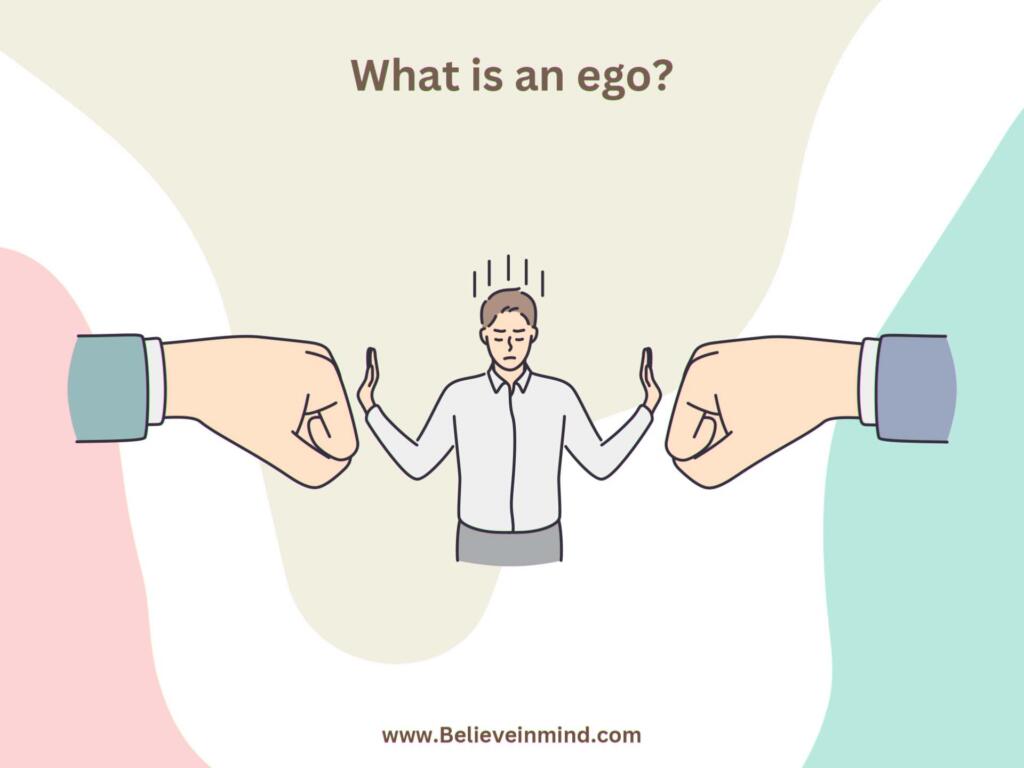
Ego is one of the oldest players in our psychological game, rooted deeply in fear, identity, and self-defense. At its core, ego’s job is to protect us — to keep our vulnerable self safe from threats, whether real or imagined. It’s the voice inside that screams when we feel attacked, rejected, or uncertain about our place in the world.
This protective instinct isn’t all bad. In fact, ego can be a powerful force for good. It fuels ambition, drives us to push past fear, and helps us survive when life gets tough. Think of ego as a kind of built-in alarm system, alerting us to danger and giving us the courage to face challenges head-on. It’s the part that stands tall and says, “I’m here, I matter,” especially when the world seems to say otherwise.
But ego has its downsides. Because it’s based on defense, it’s often reactive and sensitive. It can make us defensive or overly competitive, obsessed with being right or appearing better than others. The louder ego gets, the more it sabotages real growth and connection — turning fear into pride, and pride into stubbornness. You might notice ego when someone can’t admit mistakes, brags excessively, or fears failure so much that they avoid risks altogether.
A fitting metaphor for ego is a mask — something we wear to hide what feels fragile inside. It’s a loud protector, sometimes necessary, but often hiding the real truth beneath the surface.
The opposite of an ego is not actually “self-esteem.” Instead, it’s simply the absence of one or more aspects of one’s identity (such as race). Self-esteem refers specifically, only when speaking about how someone feels about themselves, their value as individuals, or their worthiness for love and affection etc.
Difference Between Ego and Self-esteem
The concept of ego and self-esteem has been around for centuries. But what is the difference between them? How are they related, and which one should you focus on? Well, let’s dive into this topic and find out.
| Aspect | Ego (The Loud Protector) | Self-Esteem(The Quiet anchor) |
| Root Causese | fear, identity, defense | Internal validation, self-acceptance |
| Role | Protects by masking vulnerability | Anchors with honest self-reflection |
| Upside | Drives ambition and courage | Builds peaceful confidence and resilience |
| Downside | Reactive,defensive,sabotages growth | Can seem passive or weak in loud world |
| Metaphor | Mask worn to protect the vulnerable core | Mirror reflecting true self |
| Common Signs | Needing to always be right, boasting, fear of failure. | HEalthy boundaries, accepting criticism and genuine connection |
Difference between ego and self-esteem
Lets talk about some differences properly.
1. Reaction vs. Response
Ego reacts quickly and emotionally, often defensively. It’s about protecting itself in the moment, sometimes at the cost of logic or connection. Self-esteem, on the other hand, responds with calm thoughtfulness. It pauses, reflects, and chooses how to act rather than simply reacting.
Example: In an argument with a friend, ego jumps to defend or attack. Self-esteem listens and replies with understanding.
2. Inflated Identity vs. Authentic Identity
Ego builds an exaggerated, sometimes fragile sense of self—needing to appear strong or perfect to others. Self-esteem is rooted in authenticity, accepting flaws and strengths equally.
Example: At work, ego takes credit for all successes and hides mistakes; self-esteem shares achievements openly and learns from failures.
3. External Validation vs. Internal Validation
Ego depends heavily on praise and approval from others to feel worthy. Self-esteem comes from within—it’s about knowing your value regardless of outside opinions.
Example: Ego needs likes and compliments on social media to feel good; self-esteem feels secure whether or not anyone notices.
4. Control vs. Confidence
Ego tries to control situations and people to maintain its sense of importance. Self-esteem trusts itself enough to accept uncertainty and flow with life’s ups and downs.
Example: Facing a setback, ego blames others or fights to regain control; self-esteem accepts what happened and focuses on what can be done next.
5. Competition vs. Connection
Ego thrives on competition, seeing others as rivals. Self-esteem fosters connection and cooperation, valuing relationships over winning.
Example: In a relationship, ego competes for attention and dominance; self-esteem seeks mutual respect and understanding.
6. Fear of Vulnerability vs. Embracing Vulnerability
Ego fears showing weakness or imperfection because it feels unsafe. Self-esteem embraces vulnerability as a sign of strength and authenticity.
Example: Ego hides mistakes to avoid judgment; self-esteem admits flaws and asks for help when needed.
7. Fixed Mindset vs. Growth Mindset
Ego resists change to protect its image. Self-esteem is open to learning and evolving without feeling threatened.
Example: Ego defends “I’m always right”; self-esteem says, “I can grow from this experience.”
8. Judgmental vs. Compassionate
Ego judges others harshly to feel superior. Self-esteem practices compassion toward self and others.
Example: Ego criticizes a colleague’s mistake; self-esteem offers support and understanding.
9. Anxiety Driven vs. Peace Oriented
Ego often creates anxiety by obsessing over status and control. Self-esteem brings peace by accepting imperfection and uncertainty.
Example: Ego worries obsessively about what others think; self-esteem stays calm knowing worth isn’t dependent on opinions.
Common Confusions
Ego and self-esteem often get tangled up in conversation—used interchangeably, misunderstood, or oversimplified. But the truth is, the relationship between them is far more nuanced. Ego isn’t always bad. Self-esteem isn’t always loud. And sometimes, what looks like confidence on the surface is just a clever disguise for inner uncertainty.
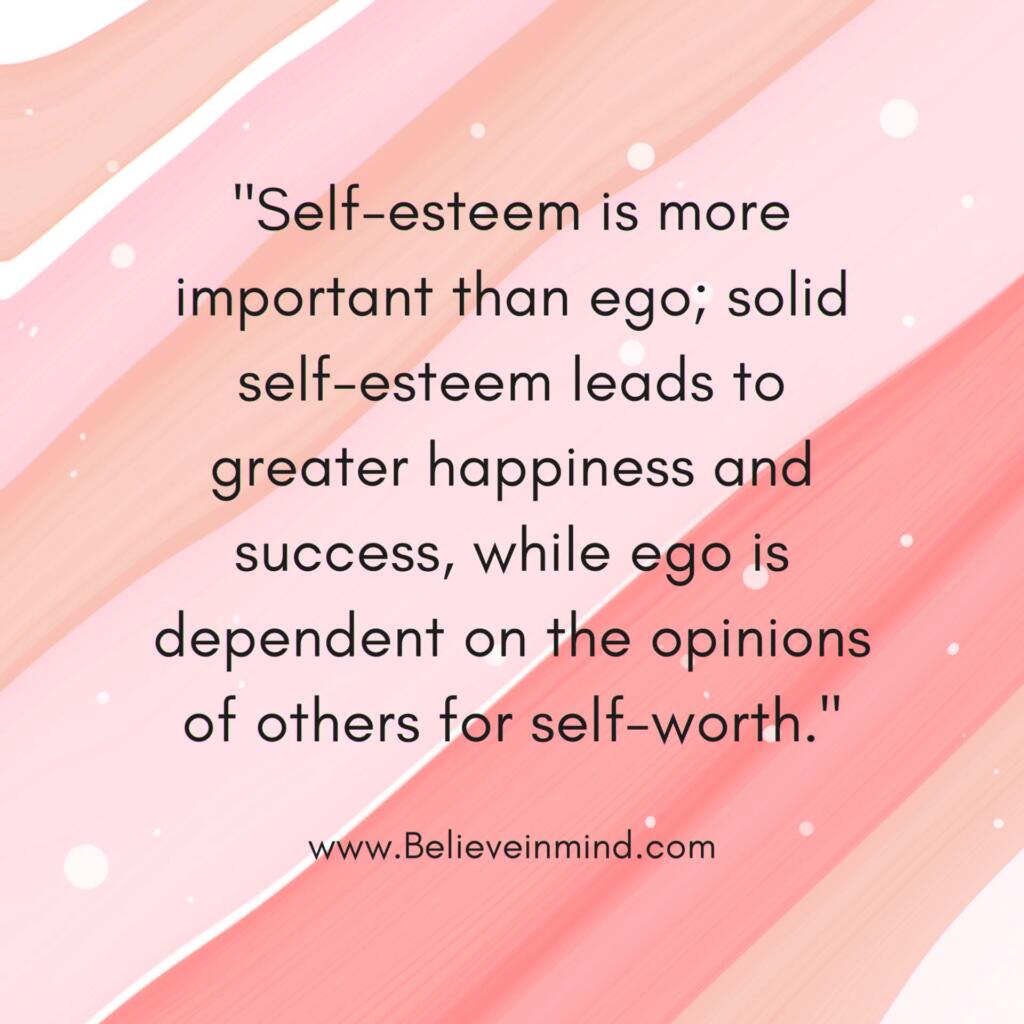
Do People with High Self-Esteem Have Strong Egos?
At first glance, confidence and ego can look alike—both can carry a certain presence, assertiveness, even power. But peel back the surface, and they’re fundamentally different forces. So, do people with high self-esteem also have strong egos?
The short answer: not necessarily. And when they do coexist, it’s all about the balance.
Psychologically speaking, ego is the part of the mind that mediates between the conscious and unconscious, often tied to identity and self-preservation (Freud, 1923). It’s reactive by nature, shaped by fear, comparison, and control. It wants to protect the self-image, often by avoiding failure or seeking superiority.
Self-esteem, however, is the stable sense of self-worth—a belief in one’s inherent value. According to psychologist Nathaniel Branden, a pioneer in self-esteem research, it is “the disposition to experience oneself as competent to cope with the basic challenges of life and as worthy of happiness.”
Where ego says, “I must win to matter,”
Self-esteem says, “I matter whether I win or not.”
High Self-Esteem Doesn’t Require a Loud Ego
People with high self-esteem often exhibit what researchers call “quiet confidence.” They don’t need to dominate conversations, seek applause, or defend every opinion. Their sense of worth is internally anchored. As such, they may actually have less need for ego-driven behavior.
In fact, multiple studies link high self-esteem with greater emotional regulation and lower reactivity (Orth & Robins, 2014). These individuals are more secure in themselves, more open to feedback, and more resilient in the face of failure—traits the ego often struggles with.
Think of it like this:
“A mountain doesn’t shout to prove it’s tall. It simply stands.”
—Chinese Proverb
People with true self-esteem don’t need their ego to speak for them. They’re grounded. They know who they are without a performance.
When Ego and Self-Esteem Coexist—But in Balance
That said, ego isn’t inherently bad. In fact, a healthy ego can serve as a survival tool—a voice that helps us assert ourselves in moments of threat or stand our ground when necessary. In people with high self-esteem, the ego is still present, but it’s not in the driver’s seat. It doesn’t dominate their identity—it simply shows up when the moment calls for it.
A healthy self knows when to wear the armor and when to take it off.
The difference lies in awareness. A self-aware person can recognize their ego rising and choose whether to act on it. That’s the mark of maturity—not the absence of ego, but the ability to manage it.
In Summary..
So, do people with high self-esteem have strong egos? They might—but the ego isn’t what defines their strength.
The real power of self-esteem lies in its quiet certainty. It doesn’t need applause to feel worthy. It doesn’t panic when criticized. And when the ego does speak, it’s not out of fear—but clarity.
Proof of self-worth isn’t in how loud we are. It’s in how little we need to prove.
“It’s tempting to believe that confidence always wears a crown—but sometimes it hides behind a mask. Let’s turn the mirror now: what’s really going on when ego gets too loud?”
Do People with Big Egos Have Low Self-Esteem?
It’s one of the most intriguing psychological paradoxes: the people who appear the most confident—loud, assertive, dominant—are often the ones struggling the most with insecurity. But is it fair to assume that a big ego always masks low self-esteem?
The answer is nuanced. Not always, but often—yes.
Ego as Armor for an Unstable Core
Many individuals with inflated egos are operating from a place of compensatory behavior. According to the self-enhancement theory (Sedikides & Gregg, 2008), when individuals feel uncertain about their worth, they may project superiority as a defense. The grandiosity isn’t confidence—it’s camouflage.
This is especially common in narcissistic personality traits. Researchers like Jean Twenge and W. Keith Campbell, in their work The Narcissism Epidemic, highlight that narcissism often stems from unstable self-esteem—not too much self-love, but a desperate need to feel superior to avoid feeling small.
The louder the self-importance, the quieter the self-worth.
Childhood Roots: The Origins of Egoic Overcompensation
Developmental psychology adds another layer. When children grow up in environments where love is conditional—based on performance, obedience, or appearance—they often learn to equate worth with winning or control.
To survive emotionally, they develop egoic masks: perfectionism, arrogance, defensiveness. These are not signs of genuine confidence; they are survival adaptations. Dr. Gabor Maté, in his work on trauma and personality, notes that ego-driven personas are often “the ways we lost ourselves to be accepted.”
When Big Ego ≠ Low Self-Esteem
It’s worth noting: not every bold personality is hiding insecurity. Some people are simply expressive, assertive, or driven by temperament and healthy ambition. The key difference is whether that behavior is flexible or fragile.
- Healthy self-esteem can joke about itself, tolerate criticism, and be quiet when needed.
- Ego-based behavior cannot. It crumbles under failure or silence.
In one study published in Personality and Individual Differences (2013), individuals with explicit narcissism but low implicit self-esteem were far more reactive to perceived slights and criticism—showing signs of inner instability despite outer boldness.
Signs the Ego Is Hiding Something
- Constant need for validation or praise
- Inability to apologize or admit wrong
- Defensiveness in the face of feedback
- Obsession with comparison or competition
- Overreaction to perceived disrespect or exclusion
These aren’t confidence—they’re alarm bells.
So remember..
A big ego is not always a mirror of strength. Often, it’s a shield—polished, shiny, and loud enough to distract from the fragile sense of self behind it. While not everyone with ego-driven traits lacks self-esteem, the deeper the performance, the more important it is to ask what’s being protected.
And if the ego is always shouting, it may be because the self underneath has never truly felt safe to speak.
A Piece of more about self-esteem: How is Positive Self-esteem Essential to a Successful Career Plan
When Ego and Self-Esteem Show Up in Life
Understanding ego and self-esteem conceptually is one thing. But how do they play out in the everyday? In quiet moments, high-stakes conversations, or gut-check decisions?
Let’s walk through a few familiar situations—moments where the difference between ego and self-esteem isn’t just psychological, but personal.
1. Job Interview
- Ego says: “Impress them. Be the best. Hide the cracks.”
You talk fast. Overcompensate. Walk out wondering if they saw through you.
If you don’t get it, it feels like a personal failure. - Self-esteem says: “Show up with what’s real. You’re not auditioning for approval—you’re offering your value.”
You speak clearly, ask questions, stay curious.
If it’s not a fit, you don’t shrink—you redirect.
2. Conflict with a Friend
- Ego says: “They made you feel small. Make them feel smaller.”
You withdraw. Or fire back. You replay the moment for days.
Being right matters more than being close. - Self-esteem says: “This hurt. But closeness can survive discomfort.”
You take a breath. You reach out without needing to win.
You ask what they felt instead of defending what you meant.
3. Facing Failure
- Ego says: “See? You were never enough.”
You spiral. Or blame. Or walk away.
You’d rather quit than be seen struggling. - Self-esteem says: “You fell. That means you tried.”
You sit with the sting, but don’t live in it.
You mine the moment for wisdom—not identity.
4. Taking Creative Risks
- Ego says: “It has to be perfect or it’s embarrassing.”
You hesitate. Rewrite the same line ten times.
You’d rather keep it in a folder than face silence. - Self-esteem says: “It’s okay to be seen unfinished.”
You release the work—even if it trembles.
Feedback doesn’t shake you, it shapes you.
The Pattern: Ego Protects, Self-Esteem Liberates
When ego leads, fear often follows—fear of rejection, of being wrong, of not being enough. When self-esteem leads, we meet life from a grounded place—with openness, resilience, and grace.
In the end, the question isn’t “Who wins?” but “Who grows?” And self-esteem always leaves the door open for growth.
Conclusion
In the end, ego and self-esteem aren’t enemies. They’re just different voices.
Ego demands attention. It wants to be seen, heard, applauded. It protects us from vulnerability, but sometimes at the cost of authenticity.
Self-esteem, on the other hand, doesn’t raise its voice. It doesn’t need to. It comes from a place that’s quieter—but deeper. It offers us clarity, direction, peace.
Growth isn’t about silencing the ego forever. It’s about knowing when to set the mask down and meet your own eyes in the mirror.
It’s choosing internal steadiness over external noise.
It’s recognizing that you don’t have to perform strength—you can embody it.
Because at the end of the day:
“The mask demands the world’s attention.
The mirror quietly gives you your own.”
Walk away lighter.
Reference
- Difference between Ego and Self Respect
- Freud, S. (1923). The Ego and the Id
- Baumeister, R. F., Campbell, J. D., Krueger, J. I., & Vohs, K. D. (2003). Does high self-esteem cause better performance, interpersonal success, happiness, or healthier lifestyles? PsycNET Record Display
- Bushman, B. J., & Baumeister, R. F. (1998). Threatened egotism, narcissism, self-esteem, and direct and displaced aggression.
- Orth, U., Robins, R. W., & Widaman, K. F. (2012). Life-span development of self-esteem and its effects on important life outcomes.
- Jung, C. G. (1953). Psychological Aspects of the Personality.

Let’s boost your self-growth with Believe in Mind.
Interested in self-reflection tips, learning hacks, and knowing ways to calm down your mind? We offer you the best content which you have been looking for.