


Sometimes, things finally start to feel okay. Not exciting. Not perfect. Just steady. The kind of calm that shows up late in the evening, when the day is finally done and there’s nothing urgent left to respond to.
And yet, instead of settling into it, something tightens — a shallow breath, shoulders that won’t fully drop. There’s a strange restlessness. A subtle urge to stay alert. Almost like waiting for something to go wrong, even while sitting in a quiet room.
It’s hard to explain. It doesn’t arrive loudly. It slips in during still moments, when the noise has already faded. This feeling doesn’t come during chaos. It appears after surviving it.
And noticing it often brings an uncomfortable question: Why is it so hard to stay happy when happiness finally shows up?
Table of Contents
When Happiness Finally Arrives, Something Feels Off
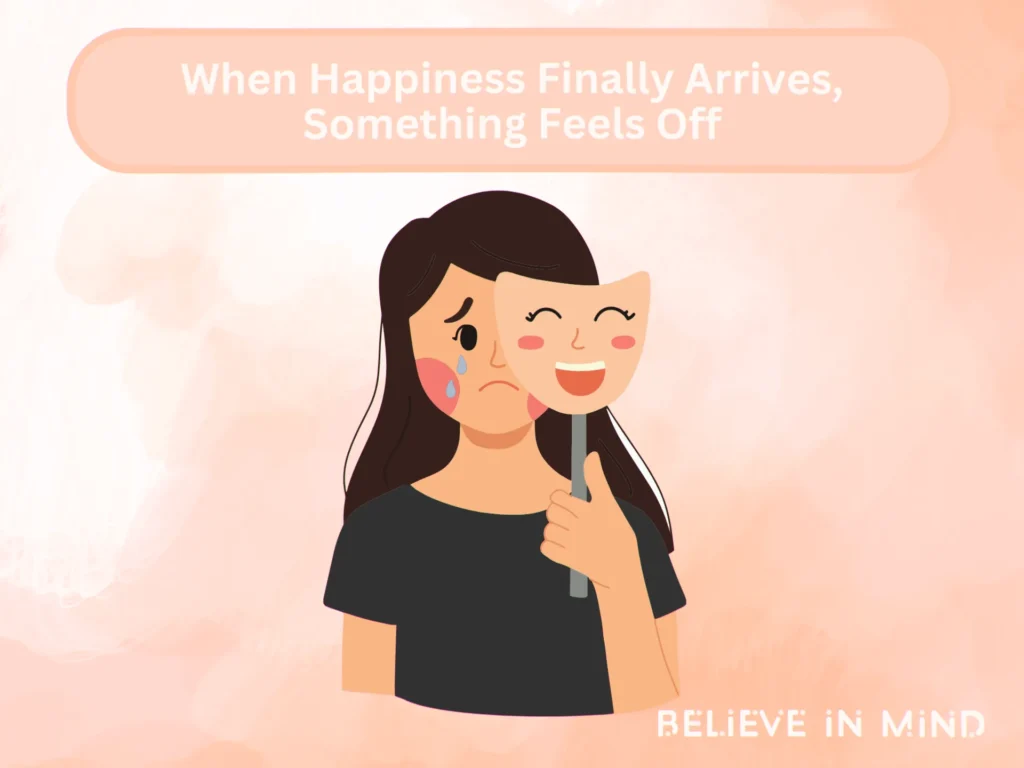
It’s strange how relief can feel heavy. After days, months, or even years of holding things together, finally reaching a point where life seems “okay” doesn’t always bring peace. Instead, it can feel… off.
The quiet moments after the storm often carry a tension all their own. There’s a subtle alertness that creeps in, like the body hasn’t quite caught up with the mind. Even when nothing urgent is demanding attention, the shoulders stay tight. Breaths come shallower than usual. The heart beats with the faint rhythm of caution, as if the calm itself might suddenly break.
This unease rarely appears during chaos. When the world is spinning, survival takes center stage. Every action, every thought, is directed at getting through the day. There’s no room for self-reflection, no space to notice the delicate ache of quiet. Only once the noise fades do these small but insistent feelings slip in, like whispers in an empty room.
Sometimes, it’s a thought that crosses the mind for a fraction of a second: Why am I not happier? Why doesn’t this feel like enough? Other times, it’s a body sensation — the stomach tightening, a fleeting tension in the chest, a restless leg that won’t settle. It’s not dramatic. It’s quiet, persistent, and oddly stubborn.
It’s almost as if the mind has been conditioned to expect struggle, and when struggle doesn’t arrive, it doesn’t know how to react. Happiness is unfamiliar territory, a sensation that the nervous system doesn’t yet trust. There’s a subtle fear that the calm will disappear if fully embraced, so a small part of the body and mind refuses to let go.
This tension is not weakness. It’s survival instincts carrying over into a different terrain. For so long, attention was devoted to crisis management, to staying afloat. Now, the mind is left to navigate a quieter world, and without the constant tasks to fill it, small uncertainties feel larger than they really are.
Read more

The Quiet Ways We Pull Away From What Feels Good
There’s a moment many people recognize, even if they’ve never spoken it out loud.
Something finally goes right. Not dramatically — just enough to bring relief. A problem eases. A relationship feels stable for a while. Life stops pressing quite so hard. And instead of sinking into that goodness, there’s a strange hesitation. Almost like standing at the edge of something warm and familiar… yet not stepping fully inside.
This isn’t because happiness feels fake. It’s because, somewhere deep down, it feels undeserved.
When you’ve spent a long time surviving — managing, adjusting, holding things together — your nervous system learns a certain rhythm. Tension becomes normal. Alertness becomes safety. Calm, on the other hand, feels unfamiliar. And unfamiliar things, even good ones, can trigger unease.
So without consciously deciding to, you begin to pull back. And this happens in many quiet, almost invisible ways:
1. Overthinking Peaceful Moments: It sounds counterintuitive, but calm can be uncomfortable. A rare afternoon free from tasks can turn into a mental maze: Did I forget something? What should I do next? Am I wasting this time? Instead of absorbing the peace, the mind churns. Overthinking transforms a gentle moment into a pressure cooker, and the relief that could have existed slips away before it’s even noticed.
2. Creating Distance Instead of Closeness: Even when surrounded by friends, family, or loved ones, there’s often a hesitation to lean in fully. It’s not distrust — it’s subtle fear. Fear that intimacy might reveal vulnerabilities, or that getting close could lead to disappointment. So we pull back, quietly erecting walls, leaving connection incomplete. Happiness exists just beyond the barrier we construct ourselves.
3. Delaying Joy: Whether it’s a planned trip, a hobby, or simply taking a break, we put off moments that could bring us pleasure. The brain convinces us that later is safer, that responsibility must come first. But in postponing joy, we unknowingly postpone relief too. Days, weeks, even months pass while happiness waits at the door, and we remain just outside, hesitant to open it.
4. Choosing Familiarity Over Contentment: Our minds cling to what’s known, even if it no longer brings satisfaction. The same routines, habits, and thought patterns feel secure, while anything new feels risky. Even if a change could lead to a better outcome, familiarity seduces us with comfort. We opt for the predictable loop, often mistaking security for true contentment.
5. Dampening Curiosity: New experiences, ideas, or opportunities carry excitement — and with excitement, the possibility of failure or unpredictability. To avoid discomfort, we often shrink back, quieting the curiosity that could have expanded our world. This cautious retreat keeps potential joy at bay, leaving life feeling smaller than it could be.
6. Anticipating Failure Before It Comes: Sometimes the mind plays a trick: imagining the worst-case scenario long before it has a chance to appear. A conversation, a job change, or a creative project is laced with imagined obstacles. Happiness is filtered through “what ifs,” turning promising moments into stressful premonitions. By bracing for failure prematurely, we push contentment away.
7. Undervaluing Our Own Needs: Small joys often go unnoticed: a quiet morning, a personal accomplishment, or even a simple compliment to ourselves. We convince ourselves that there’s always something more urgent or deserving of attention. By neglecting our own needs, even subtly, we deny ourselves the little moments that accumulate into lasting happiness.
Why Happiness Can Feel Unfamiliar or Unsafe
There’s a strange moment when everything seems to calm down. The fight with a colleague has ended, the deadlines are met, and the house is quiet. You’d think relief would feel easy. But instead, something in your chest tightens. You pause. You wonder if it’s real.
It’s not that life has suddenly turned against you. It’s that the mind, after years of struggle or constant stress, simply doesn’t know how to inhabit ease. Happiness feels unfamiliar, almost like stepping onto a floor that might give way beneath you.
1. The Nervous System Learns Tension
When stress is the normal state, calm feels unnatural. Your muscles remain tight, your stomach twists slightly, and the mind scans for danger even when there’s none. It’s as if the body has memorized a rhythm of alertness — every relaxed moment interrupts that rhythm. After living through storms, the first quiet day can feel like walking on thin ice: promising, but uncertain.
For example, imagine finishing a long workweek without crisis. Instead of sinking into relief, there’s a subtle restlessness: a foot tapping, shoulders tight, mind flicking through “what if” scenarios. This isn’t laziness or pessimism; it’s a body trained to survive tension.
2. Predictability Feels Safer Than Peace
The mind loves routines. Even uncomfortable ones. Familiar chaos is predictable; calm is not. So when happiness arrives, it can feel suspicious. Why is the quiet here? How long will it last?
Think of it like walking into a room that’s perfectly arranged, every item in place, sunlight streaming in. You expect a mess, a noise, a sign that life is unpredictable. When there isn’t one, part of you hesitates, scanning for an invisible trap. The mind isn’t trying to be cruel; it’s trying to protect you.
3. Happiness Feels Temporary
Joy that appears too easily is treated like a fragile vase — admired, but never fully touched. You may pause in the middle of a laughter-filled evening, almost unconsciously wondering if it will vanish. When calm feels fleeting, it triggers a subtle urge to hold back, to brace yourself.
Consider a quiet evening after months of work stress. You pour a cup of tea, sit in a soft chair, and feel a trace of contentment. But the mind whispers, “It won’t last. Something will happen.” The anticipation of loss turns the simple act of enjoying a moment into a delicate exercise in restraint.
4. Old Habits Resist Change
Even when life improves, the routines and thought patterns formed in survival mode push against new experiences. You might overthink peaceful moments, hesitate to embrace opportunities, or retreat from small joys. The brain clings to what it knows because uncertainty, even if positive, still triggers caution.
A colleague might compliment your work, a friend might invite you out, or an opportunity might arise that could improve your life. And yet, part of you hesitates — a small, internal nudge reminding you that comfort feels safer than change.
5. Anticipation of Loss
After long periods of scarcity or struggle, calm triggers subtle fear. The mind anticipates setbacks even in the absence of danger. Happiness feels fragile because it is a state that hasn’t been consistently experienced.
It’s like holding a balloon in your hand: you want to enjoy its buoyancy, but part of you expects it to slip away. You tread carefully, savoring the moment without fully committing, half-preparing for the moment it disappears.
No matter what always keep in mind that all of these responses are normal. They are not a sign of weakness or failure. They are survival mechanisms, deeply embedded through years of adaptation. The challenge is learning to notice them, naming the ways your mind hesitates, and giving yourself permission to occupy spaces of ease.
Calm isn’t unsafe; it’s unfamiliar. And just like any skill, the mind and body can learn it — gradually, gently, and with awareness.
————–
Even when the tension of unfamiliar calm begins to ease, another subtle force quietly shows up: the stories we tell ourselves. They’re the background narration of the mind, the whispers that turn a peaceful evening into a moment of mild anxiety.
“This won’t last,” one voice murmurs, almost automatically, as if rehearsing a familiar script. “Something usually goes wrong,” says another, echoing past experiences when relief did vanish. And sometimes, the mind offers a seemingly reasonable compromise: “I’ll enjoy it later, when things feel more stable.”
These aren’t conscious thoughts we choose to believe. They are the echoes of survival, habits formed in the crucible of stress, hardship, or long-standing uncertainty. They pop up in quiet moments, subtly pulling us back from the happiness that has finally arrived.
For example, imagine sitting down after a long day, a cup of tea warming your hands. The room is quiet, soft light spilling across the walls. For a brief moment, everything feels fine. And yet, almost imperceptibly, your mind begins to chatter: What if tomorrow is stressful again? Did I miss something today? Should I start planning for possible problems now?
Without realizing it, these stories guide behavior. They make you delay pleasure, double-check decisions, or keep parts of yourself guarded. Over time, they reinforce the idea that happiness is temporary — a fragile state that must be earned, guarded, or postponed.
Why This Pattern Isn’t a Personal Failure? After spending so much time surviving, adjusting, and protecting yourself, pulling away from happiness isn’t a flaw — it’s a learned response. Your nervous system, mind, and habits have been trained to expect tension, uncertainty, and vigilance. Calm moments feel foreign, so hesitation or subtle self-sabotage is almost automatic.
This pattern develops slowly over time. It’s not a sudden choice to push joy away; it’s a response shaped by countless small experiences — moments where you had to stay alert, be cautious, or prioritize safety over pleasure.
There’s a difference between protecting yourself and “ruining things.” Pulling back from happiness isn’t a moral failing or evidence that you’re incapable of joy. It’s a strategy your mind uses to manage risk, even when the risk is no longer present.
Intention matters more than outcome. You may notice yourself hesitating, overthinking, or delaying enjoyment, but the fact that you care about your well-being shows that you’re not careless — you’re human. Understanding this removes shame and self-blame, creating space for compassion toward yourself.
In short, the pattern isn’t a personal failure. It’s a reflection of the way your mind and body learned to navigate a world that often demanded vigilance. Recognizing it is the first step toward gently experimenting with letting happiness in, without pressure or guilt.
Letting the Pattern Be Seen Without Forcing Change
By now, you might notice the pattern — the subtle pullback, the hesitation, the way happiness sometimes feels just out of reach. It’s not about failure, or weakness, or something being “wrong” with you. It’s simply part of how the mind and body have learned to navigate life.
The key here is not to fix it. There’s power in simply noticing. When you become aware of your tendency to pull away, you don’t have to judge it or erase it. You don’t have to rush toward perfect happiness or force contentment. Observation itself is enough — a quiet acknowledgment that this is how you respond, and that it’s okay.
Let happiness linger without pressure. Let the calm settle in your chest for a few breaths longer than you normally would. Let yourself feel the relief, the warmth, the subtle joy — even if a small voice inside whispers that it might not last. By simply allowing, without trying to control or perfect the moment, you practice a gentle form of presence that honors your experience.
This is the final invitation: notice without rushing, allow without pushing, reflect without instruction. In that gentle space, even a fleeting moment of peace becomes meaningful. It doesn’t have to be earned. It doesn’t have to be perfect. It simply is, and that’s enough.
Further Reading List
- BOOKS
- “The Happiness Trap” by Russ Harris – A practical guide to accepting emotions, overcoming self-sabotage, and living a meaningful life.
- “Radical Acceptance” by Tara Brach – Explores why we resist happiness and how self-compassion can free us from habitual patterns.
- “Emotional Agility” by Susan David – Offers strategies for recognizing and letting go of self-limiting behaviors, including sabotaging happiness.
- “The Happiness Trap” by Russ Harris – A practical guide to accepting emotions, overcoming self-sabotage, and living a meaningful life.
- TED TALKS
- “The Power of Vulnerability” by Brené Brown – Explores how embracing vulnerability can increase connection and joy.
- What Makes a Good Life?” by Robert Waldinger – Insights from a long-term study on happiness and fulfillment, connecting daily choices to long-term well-being.
- “The Skill of Self-Confidence” by Dr. Ivan Joseph – Discusses self-belief, personal patterns, and how we often hold ourselves back.

Let’s boost your self-growth with Believe in Mind.
Interested in self-reflection tips, learning hacks, and knowing ways to calm down your mind? We offer you the best content which you have been looking for.