

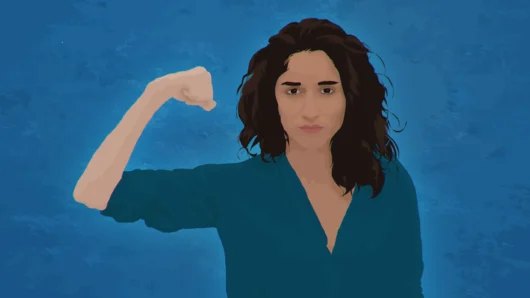
Not all battles are loud.
Some happen in quiet rooms, behind unread messages, beneath forced smiles, in the pause before someone says, “I’m fine.” There are no witnesses to these moments. No applause. No clear beginning or end. Just a person, standing at the edge of their own limits, deciding—sometimes reluctantly, sometimes desperately—to take one more step forward.
Resilience is often misunderstood because we only recognize it in its most visible form. We celebrate the comeback story, the breakthrough, the moment everything finally works out. But what we don’t often see are the countless invisible decisions that came before it—the days when nothing improved, the nights filled with doubt, the small, almost insignificant choices to keep going anyway.
This is where stories matter.
Not because they solve anything instantly, but because they remind us that endurance has many faces. That strength is not reserved for the extraordinary. That even in the most uncertain chapters, there is a quiet kind of persistence unfolding beneath the surface.
The stories you’re about to read are reflections of something deeply familiar moments of loss, hesitation, rebuilding, and the fragile but powerful decision to try again. Each character stands in a place many of us have been or may find ourselves in someday.
As a person who personally experience most of this moment, I hope these will help you even a single bit.
Table of Contents
If you’re here looking for motivation, you might not find it in the way you expect. There are no shortcuts hidden in these pages, no instant transformations. But what you may find is something steadier—something more lasting.
A sense that even when progress feels invisible, it is still happening. That even when strength feels out of reach, it is still present in quieter forms. And sometimes, that is enough to begin again..
1. Erik Weihenmayer: Beyond the Highest Peak
“Don’t let this be the greatest thing you ever do.”
It’s not what most people expect to hear after reaching the top of the world. But for Erik Weihenmayer, standing on the summit of Mount Everest in 2001 was never meant to be the end of the story.
It was just proof of what was possible.
Erik had been blind since the age of 13. In a world built heavily around sight, he learned to navigate differently—not by seeing the path ahead, but by interpreting it. On Everest, that meant listening to the faint ringing of bells attached to climbers in front of him, using sound as direction. It meant reading the mountain through his trekking poles, feeling subtle changes in ice, slope, and texture.
Every step forward was an act of trust—trust in his team, his senses, and himself.
In 2014, Erik traded the silence of the peaks for the roar of the Colorado River. Kayaking 277 miles through the Grand Canyon meant navigating some of the world’s most violent whitewater blind. He couldn’t see the ‘tongue’ of the rapid or the ‘holes’ that could flip a boat. Instead, he learned to hear the river’s architecture, the rhythm of the water. He described the sound of a massive rapid as a ‘freight train’ or a ‘low-frequency growl’ that vibrated in his chest.
By listening to the way the water bounced off the canyon walls, he could sense the obstacles ahead, proving that resilience isn’t just about pushing through—it’s about tuning in to a different frequency of reality
Reaching Everest would have been enough for most. It’s a lifetime achievement, even for elite climbers. But Erik didn’t stop there. He went on to conquer the Seven Summits—the highest peaks on every continent—something only a small number of climbers in the world have ever done.
And still, he kept going. Different terrain. Different risks. Same mindset.
Erik’s story isn’t just about overcoming blindness. It’s about refusing to let any single achievement define your limits. Real resilience, in his case, wasn’t reaching the top—it was deciding that the top was never the finish line.
Read more

2. Rising from the Ashes: Turia Pitt’s Reconstruction
Before her life was redefined by fire, Turia Pitt was a mining engineer and an elite athlete who thrived on the grit of endurance races. In 2011, during a 100km ultramarathon in the Australian outback, a catastrophic wildfire trapped her in a narrow gorge. There was no escape. She was engulfed by a wall of flames that left her with full-thickness burns to 65% of her body.
What followed was not a typical “inspiration” story. It was a clinical, grueling, and uncertain battle for survival. Turia lost seven fingers, spent 864 days in the hospital, and endured more than 200 surgeries. For two years, she lived inside a full-body compression suit and a plastic mask to protect her healing skin. Doctors doubted she would ever walk again, let alone return to the world of athletics.
This is where Turia’s story shifts away from abstract emotion and into the realm of mechanical resilience.
She approached her recovery like the engineer she was trained to be. Instead of leaning on vague positivity, she treated her body as a complex system that needed to be rebuilt from the ground up. She broke the “impossible” task of recovery into small, solvable problems.
When she couldn’t stand, she didn’t visualize a marathon; she focused on a single, almost invisible input: move one toe. That was the first milestone. Not a step, not a walk—just a signal that the system could still respond to a command.
Her resilience was technical. Because her scarred skin could no longer sweat to regulate her body temperature, she had to engineer new ways to stay cool. Every training session was a calculation of heart rate, external temperature, and physical limits.
In 2016, five years after she was nearly burned to ash, Turia stood at the starting line of the Ironman World Championship in Kona, Hawaii. She completed the 3.8km swim, the 180km bike ride, and the full 42.2km marathon.
But perhaps the most human element of her story is the partnership that sustained the reconstruction. While she was still in intensive care, her partner, Michael Hoskin, bought a diamond ring. When asked later if he ever considered leaving, his response was a masterclass in character: “I married her soul, her character, and she’s the only woman that will continue to fulfill my dreams.”
Turia Pitt did not “bounce back” to her old life; she engineered a new one. Today, she is a best-selling author and a mother of two, proving that resilience isn’t about luck or “feeling” brave—it’s about the deliberate, disciplined work of rebuilding, one small step at a time.
Read more
3. Bethany Hamilton: The Unsinkable Spirit
Life is full of challenges. Some people let difficulties defeat them, while others use adversity as an opportunity to grow. A story that belongs to the title could go like this:
“I don’t need easy. I just need possible.”
For Bethany Hamilton, that mindset didn’t arrive after years of reflection; it surfaced in the immediate aftermath of trauma. In 2003, while surfing her home break in Kauai, a 14-foot tiger shark attacked, severing her left arm just below the shoulder. She lost 60% of her blood and narrowly escaped with her life.
In a sport like surfing, this was more than a medical emergency—it was a total disruption of physics. Surfing depends on symmetry. Paddling requires equal power on both sides to catch a wave. The “pop-up”—the explosive, split-second motion of pushing from a lying position to a standing one—relies on both arms acting as synchronized pistons.
Most assumed her career was over before it had truly begun. Bethany, however, viewed her situation not as a loss to accept, but as a technical problem to solve.
The solution wasn’t found in abstract motivation, but in gear modification. With her father’s help, she adapted her surfboard by installing a custom handle in the center of the deck. This allowed her to pull herself up with one arm and gave her a way to “duck-dive”—holding her board underwater to move beneath massive breaking waves.
Then came the challenge of the paddle. Without a left arm, her board naturally pulled to one side. She had to reinvent her stroke, learning to paddle in a calculated, slight circular motion to maintain a straight line. It required a level of sensory precision and core strength that able-bodied surfers never have to develop.
The result of this reinvention was staggering. Only 26 days after the attack, Bethany returned to the ocean.
She didn’t just learn to surf again; she mastered a new way of moving. By 2016, at the Fiji Women’s Pro, she competed as a wildcard and defeated the world’s number-one ranked surfer. Her perceived limitation had forced her to become more technically aware and more adaptive than those with two arms.
Bethany’s story proves that resilience isn’t about waiting for the storm to pass. It is about re-engineering your approach so you can step back into the water with a new understanding of what is possible.
4. The Silence and the Soul: Adele
For a singer whose entire identity is anchored in the power of her voice, the greatest “storm” isn’t a bad review—it is the prospect of absolute silence.
In 2011, at the peak of her global breakthrough with the album 21, Adele’s world went quiet. She was diagnosed with a vocal cord hemorrhage caused by a benign polyp. This wasn’t just a strained throat; her vocal cords were physically bleeding. To save her career, she had to undergo a high-risk laser microsurgery to “reconstruct” the delicate tissue of her instrument.
The recovery demanded something arguably harder than the surgery itself: sixty days of absolute silence. For two months, one of the world’s most famous voices was forbidden from speaking, laughing, or humming. She communicated entirely through notebooks and phone apps. This period wasn’t just a break; it was a technical “reboot.” She used the stillness to overhaul her lifestyle, quitting smoking and re-training her vocal habits to protect the “system” she had nearly shattered.
The moment of truth came at the 2012 Grammy Awards. Standing before millions, she opened her mouth to sing the first notes of “Rolling in the Deep.” The voice that emerged wasn’t just healed—it was transformed. It was richer, more controlled, and more resonant than ever before. She swept six awards that night, proving that her silence had been a form of preparation, not an end.
But Adele’s resilience extends beyond the physical. She has been one of the few global icons to speak openly about the “internal storms”—the crippling stage fright and the emotional “tsunami” of a high-profile divorce.
During her 2023 Las Vegas residency, she shared how she uses “active rewiring” to manage her anxiety. She learned that resilience isn’t about being “fearless” or having a perfect routine; it’s about the deliberate choice to walk onto the stage even when the routine fails. She began to treat her mental health like her vocal health: a system that requires constant, honest maintenance.
Adele’s story teaches us that resilience isn’t a loud, singular roar. Sometimes, it is the quiet discipline of a sixty-day silence, the courage to rebuild a broken heart, and the strength to admit that even the most powerful voices need time to heal.
5. Spencer West: Redefining the Summit
Most people measure strength by what the body can do. Spencer West redefined it by what the mind refuses to give up on.
At the age of five, Spencer lost both of his legs due to a genetic condition. Years later, in 2012, he set his sights on something most fully able-bodied people would never attempt—climbing Mount Kilimanjaro, standing at 5,895 meters. But this wasn’t just a personal challenge. It was a mission to raise funds for clean water.
The plan included a custom wheelchair. The reality? The mountain didn’t care about plans.
Only about 20% of the journey allowed the use of his wheelchair. The rest forced him onto his hands pulling, lifting, and pushing his body forward across rock, dust, and steep inclines. Every meter demanded more than physical endurance; it required relentless mental strength.
But the most defining moment came near the top.
On the final summit day, exhaustion and altitude began to take their toll—not on Spencer, but on his two closest friends, the very people who had come to support him. Both were hit with severe altitude sickness. The roles suddenly reversed.
The man who many assumed would need the most help emotionally, mentally, and in spirit. Despite having no legs, Spencer didn’t give in. He pushed forward and, more importantly, pulled his team with him. Step by step, he led them to the summit.
What makes this story powerful isn’t just that he reached the top. It’s that in the harshest moment; resilience didn’t look like survival; it looked like leadership.
Sometimes, the strongest person in the room isn’t the one with the most physical ability. It’s the one who refuses to stop when stopping feels justified.
Read more

5. The Phoenix’s Flight: Niki Lauda
In 1976, Niki Lauda was the reigning Formula 1 World Champion and the leader of the Ferrari team. He was a man of cold logic and precision—until he met the fire.
During the German Grand Prix at the Nürburgring, a track so dangerous it was nicknamed “The Green Hell,” Lauda’s Ferrari suffered a rear suspension failure. His car slammed into the embankment, burst into flames, and was struck by another vehicle. Trapped in a inferno for nearly a minute, Lauda inhaled toxic gases that scorched his lungs and suffered third-degree burns to his head and face.
At the hospital, a priest was called to his bedside to administer the Last Rites. The world believed the Phoenix had fallen for the last time.
But Niki Lauda did not accept the ending.
His resilience was not a sudden burst of inspiration; it was a grueling, agonizing reconstruction. To clear his scorched lungs of the toxic fluids that were suffocating him, he had to undergo a procedure where a tube was inserted down his throat to vacuum out the debris—while he was fully conscious. He later described it as the most painful experience of his life, yet he demanded the doctors do it repeatedly so he could breathe again.
Only 42 days after he was given up for dead, the “Phoenix” took flight.
With his face still bandaged and his wounds bleeding into his fireproof balaclava, Lauda climbed back into his Ferrari at the Italian Grand Prix. He was so physically fragile that he had to have his helmet modified just to fit over his bandages. Despite the intense physical pain and the psychological trauma of the crash, he finished the race in 4th place.
Lauda didn’t just return to survive; he returned to dominate. He went on to win two more World Championships (1977 and 1984), proving that the fire hadn’t destroyed his spirit—it had tempered it.
His story is the literal definition of the Phoenix: not because he was untouched by the flames, but because he used the very scars they left behind to navigate his way back to the top.
Further Readings
- Erik Weihenmayer From Wikipedia, the free encyclopedia
- Spencer West From Wikipedia, the free encyclopedia
- Turia Pitt: Australian athlete and author.
- Bethany Hamilton: American surfer
- Adele’s history of cancelled shows and health issues after latest Las Vegas news. Roisin O’Connor Wednesday 28 February 2024, from INDEPENDENT

Let’s boost your self-growth with Believe in Mind.
Interested in self-reflection tips, learning hacks, and knowing ways to calm down your mind? We offer you the best content which you have been looking for.