


Somewhere along the way, we learned to live in pieces.
We sharpened our minds but neglected our bodies.
We showed up for others while abandoning our own emotional needs.
We pushed through exhaustion and called it strength.
We silenced the soft, sacred voice within—the one that kept whispering,
“There’s more to life than this.”
This isn’t a flaw in you. It’s a survival skill in a world that forgot how to rest. A world that rewards speed over stillness, doing over being, and perfection over presence.
“You are not a drop in the ocean. You are the entire ocean in a drop.”
— Rumi
And yet—beneath the noise, beneath the performance—your deeper self still remembers. It remembers how it feels to be whole.
But to find your way back, you have to pause long enough to ask:
What would it look like to live in wholeness again?
– To befriend your mind instead of judging it,
– to feel your feelings without shame,
– to honor your body not as a machine but as a sacred home,
– to nourish your spirit with kindness and presence—without apology or delay?
Because a holistic mindset isn’t a wellness trend or a checklist to complete. It’s a quiet revolution within.
– A gentle reorientation.
– A way of seeing yourself as a complete ecosystem—where every part of you matters, is sacred, and belongs.
It’s not about becoming someone new.
It’s about returning to someone ancient. Someone wise. Someone whole.
You.
Table of Contents
What Is a Holistic Mindset? (And What It’s Not)
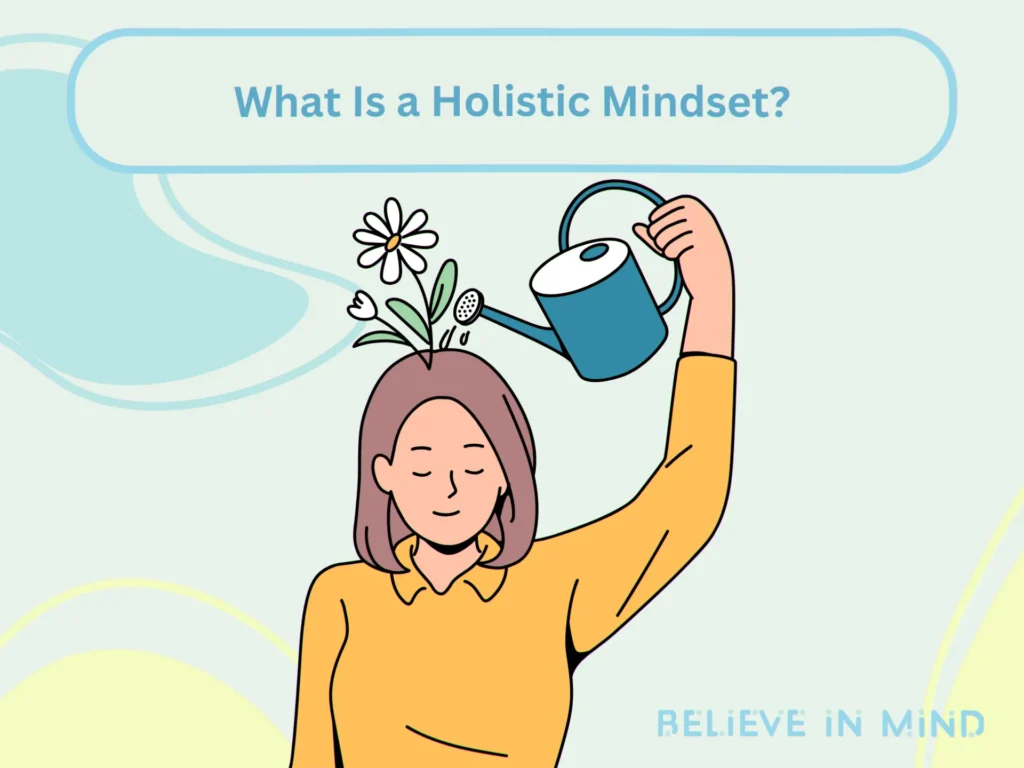
At its core, a holistic mindset is a way of seeing yourself—and your life—as a whole, interconnected system. It means understanding that your mental thoughts, emotional experiences, physical sensations, and spiritual yearnings aren’t separate islands, but parts of one living landscape.
This is not about “fixing” yourself as if you’re broken. It’s not a checklist of habits, a trendy wellness routine, or a performance to impress others. Instead, it’s a gentle realignment—an invitation to embrace all parts of you with curiosity and compassion.
Psychology confirms what ancient wisdom has long taught: true well-being requires integration, not fragmentation.
- Research in mind-body medicine shows that the brain, body, and emotions are deeply connected. The American Psychological Association (APA) highlights that practices encouraging this connection—like mindfulness and somatic awareness—can reduce stress, improve emotional regulation, and enhance resilience (APA, 2019).
- Studies on emotional intelligence demonstrate that awareness and acceptance of our feelings lead to healthier relationships and better mental health outcomes (Mayer, Salovey, & Caruso, 2008).
- Neuroscience tells us the brain thrives on integration—when different regions communicate and work together, we experience greater emotional stability and cognitive flexibility (Siegel, 2012).
In other words, a holistic mindset is backed by science, not just idealism. It’s about aligning your inner world so that your mind, emotions, body, and spirit work in harmony, rather than conflict. When we do this, we unlock a deeper sense of peace and purpose—one that doesn’t depend on external achievement or validation.
What a holistic mindset is NOT:
- It is not ignoring problems or painful emotions.
- It is not self-indulgence or laziness.
- It is not forcing positivity or perfection.
Instead, it is a radical act of presence, acceptance, and integration.
This mindset invites you to listen to your whole self—especially the parts you may have long ignored. And from that place of deep listening, to live with authenticity and grace.
How We Get Disconnected: The Roots of Fragmentation
Living fragmented isn’t a personal failure—it’s a response to the world we inhabit. You weren’t born disconnected.
You didn’t come into this world doubting your worth, suppressing your emotions, or feeling split between your body and your mind. You were once whole—curious, expressive, instinctively aligned with your needs.
But slowly, piece by piece, that wholeness began to fade. And not because you failed. But because the world taught you to live in fragments.
Let’s gently explore how that disconnection often begins.
1. The Culture of Hustle and Compartmentalization
From an early age, you were likely praised for being productive, disciplined, and focused. You were encouraged to succeed, but not always taught how to rest. You were told to work hard, but not how to listen to your body when it was tired. You were taught how to meet expectations, but not how to ask, “What do I truly need?”
In this culture, doing often takes precedence over being.
We compartmentalize: work here, emotions there, rest someday—maybe.
As sociologist Brené Brown says, “We hustle for our worth.” And in that hustle, we often lose the deeper connection to ourselves. Psychologist Sherry Turkle calls this state “the divided self”—a modern condition where our internal life is fractured in the name of performance (Turkle, 2011).
We don’t feel whole, not because we lack anything, but because we’ve been forced to split ourselves just to survive the day.
2. Emotional Suppression and the Fear of Feeling
Think back: When you were sad, were you told to stop crying?
When you were angry, were you called dramatic or disrespectful?
When you felt joy, did you have to tone it down?
Many of us internalize the belief that our feelings are too much.
So we tuck them away—deep down.
We suppress pain, hide fear, and mask vulnerability.
But buried feelings don’t disappear. They linger in the nervous system, show up as anxiety, tension, and even illness. As psychologist Dr. Susan David notes, emotional agility—the ability to be present with our feelings—is one of the greatest predictors of resilience and wellbeing.
A 2003 study by Gross & John found that people who suppress their emotions experience less social connection, greater stress, and lower overall life satisfaction.
It’s not weakness to feel—it’s strength. Suppression may feel safe, but it disconnects us from our full humanity.
3. Mental Overload and the Age of Overthinking
The modern mind is not just busy—it’s overwhelmed.
Between work, news, deadlines, messages, and comparison-driven scrolling, our brains are running marathons without a finish line. And this constant mental noise creates distance—from presence, from peace, and from clarity.
Instead of living from within, we live from reaction. Instead of responding thoughtfully, we overthink endlessly.
Neuroscientist Dr. Dan Siegel explains that integration of brain regions—especially through practices like mindfulness—leads to greater emotional balance and well-being. But most of us have little time or space to integrate. We’re too busy keeping up.
In this overload, even joy begins to feel like a task.
4. Spiritual Drought and the Loss of Meaning
Beyond the mental and emotional lives a quieter disconnection—one we often can’t name:The loss of meaning. The fading of soul.
You may feel it as a low hum in the background. A sense that you’re doing “all the right things” but something essential is still missing. That you’re living by the clock, but out of sync with life itself.
This is a spiritual drought—not necessarily religious, but deeply human. We are wired for meaning. For something bigger than ourselves.
Studies by Michael Steger (2009) in the field of positive psychology found that individuals with a strong sense of meaning experience greater life satisfaction, psychological health, and resilience.
Yet, without connection to that deeper purpose, we often feel like we’re drifting—even if everything looks “fine” on the outside.
The truth is your disconnection is not your defect. It’s the echo of a world that forgot how to live whole.
And yet, that echo carries a message. Not to shame you—but to call you back.
To remind you: there’s nothing wrong with you for feeling tired, numb, or out of sync. You were never meant to live in fragments.
The Pillars of a Holistic Mindset
It comes from remembering what’s already there—beneath the noise, beneath the pressure, beneath the polished performance.
A holistic mindset honors the truth that you are not just a mind to train, a body to shape, or a to-do list to conquer. You are a living system—mental, emotional, physical, and spiritual—intertwined, inseparable, sacred.
When even one of these pillars is neglected, you feel it. When they’re nourished together, you begin to feel like yourself again.
Let’s gently walk through each one.
1. Mental Awareness — The Stories We Tell Ourselves
Your mind is always talking. Sometimes it whispers fear. Other times it shouts self-doubt. Often, it repeats old beliefs you didn’t choose—but absorbed.
A holistic mindset doesn’t aim to silence the mind but to understand it.
Psychologist Aaron Beck’s research into Cognitive Behavioral Therapy (CBT) shows how our thoughts shape our feelings, behaviors, and even physical well-being. When left unchecked, distorted thinking patterns (like catastrophizing, mind reading, or black-and-white thinking) become internal cages.
But awareness is power. Holistic living means pausing to ask:
“Is this thought helpful? Is it even true?”
And in doing so, you slowly untangle yourself from narratives that never belonged to you.
2. Emotional Integrity — Feeling Without Fear
Emotions are not problems to solve. They are messengers—truth-tellers pointing you toward something that needs attention, love, or change.
Yet many of us have learned to fear our own feelings. To suppress sadness. To hide anger. To smile when we’re breaking inside. But emotional suppression has a cost.
Studies show that people who regularly avoid their emotions experience higher rates of anxiety, depression, and physical illness (Gross & Levenson, 1997).
On the other hand, emotional acceptance—acknowledging feelings without judgment—supports healing, builds resilience, and fosters deeper relationships.
To live holistically is to feel honestly. To let your emotions rise and move, like waves—not walls.
“You are allowed to feel it all, and still be whole.”
3. Physical Presence — Listening to the Body’s Wisdom
Your body is not a machine to push, punish, or perfect. It is your home—your truest companion.
But when we disconnect from the body, we treat it like an afterthought. We override hunger, ignore pain, sacrifice sleep, and label exhaustion as laziness.
A holistic mindset invites a radical shift: What if you believed your body was wise?
Somatic psychology, trauma research (Van der Kolk, 2014), and nervous system science all affirm this: The body holds memory, emotion, and intelligence. It communicates through sensation—tightness, fluttering, fatigue, unease.
To heal, we must listen. This doesn’t mean a perfect diet or rigid fitness plan. It means asking daily:
“How are you today?”
“What do you need from me?”
And responding with care
4. Spiritual Anchoring — Returning to Something Deeper
You are not just your thoughts or tasks. There is a deeper self within you—the witness, the longing, the quiet place that seeks meaning.
You don’t need a religion to be spiritual. Spirituality is any practice, belief, or presence that helps you feel connected—to the present moment, to your values, to something larger than yourself.
It might be stillness.
Or nature.
Or prayer.
Or simply placing your hand on your heart and remembering that you are here.
A 2020 study in the Journal of Health Psychology found that spiritual well-being is strongly linked to reduced anxiety, greater life satisfaction, and even physical health.
A holistic mindset makes space for this connection—not as a luxury, but as a necessity.
Together, these four pillars form the inner foundation of wholeness:
- A mind you listen to, but no longer obey blindly.
- Emotions you welcome instead of suppress.
- A body you treat with respect, not resentment.
- A spirit you return to when the world pulls you away.
You don’t have to master them all at once.
You simply begin to listen again—to all the parts of you that have been waiting.
Signs You’re Out of Alignment
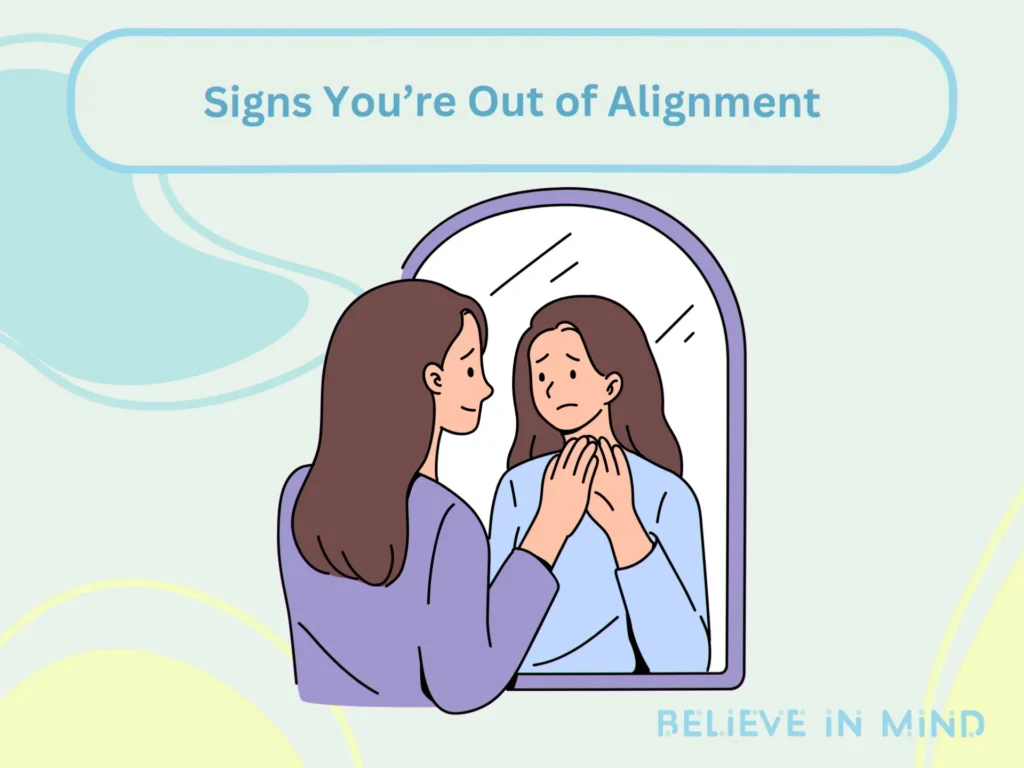
Sometimes we don’t realize we’re out of alignment until everything starts to feel heavy.
You may still show up for work. Smile at others. Post the highlight reel. But inside, something feels off. You’re tired—but not just physically. You feel unmotivated—but can’t explain why. You long for peace—but struggle to sit still with yourself. These are not failures. They’re signals—whispers from your deeper self, asking you to realign.
Here are a few quiet but powerful signs that your inner ecosystem may be out of balance:
1. You Feel Constantly Tired, Even When You Rest
You sleep, but don’t feel restored. You take breaks, but never truly exhale.
This kind of fatigue often isn’t just physical—it’s emotional and spiritual.
When your body and inner world are out of sync, rest doesn’t reach the root.
2. You’re Overthinking and Under-Feeling
You live in your head, replaying conversations, imagining worst-case scenarios, solving problems that haven’t happened yet.
Meanwhile, your emotions feel distant or muted. You’ve disconnected from what you actually feel—because thinking feels safer than feeling.
3. Your Body Feels Tense, Tight, or Numb
Your shoulders are always clenched. Your jaw is tight. Your stomach is unsettled.
Or sometimes, you just feel… nothing. This is your body holding unprocessed stress, grief, or anxiety. As Van der Kolk wrote: “The body keeps the score.”
4. You Struggle to Find Joy in Things You Once Loved
Your passions feel far away. Even the things that used to light you up now feel dull or irrelevant. This isn’t laziness or apathy—it’s often a sign that your spirit is depleted. You may be missing connection, meaning, or creative expression.
5. You Feel Emotionally Disconnected—from Yourself and Others
You have conversations, but they feel surface-level. You’re surrounded by people, yet feel alone. You’ve stopped asking yourself:
“How am I, really?”
Disconnection from self makes authentic connection with others harder.
6. You Can’t Hear Your Inner Voice Anymore
You used to know what felt right or wrong. You trusted your gut.But now, it feels like you’re moving through life on autopilot. You second-guess everything. Your intuition is muffled under noise and pressure.
These aren’t signs that you’re broken. They’re signs that you’ve been surviving in a world that encourages disconnection.
And here’s the good news:
What became fragmented can be gently reunited.
What feels scattered can be brought back into rhythm.
You don’t need to fix yourself.
You just need to listen differently.
Cultivating a Holistic Mindset — Where to Begin
You don’t need to overhaul your life to begin living holistically.
You just need to start noticing and nurturing the parts of yourself you’ve been taught to overlook.
Here are simple, realistic steps anyone can take—no matter your schedule, background, or starting point.
1. Practice Mindful Breathing to Reconnect Your Mind and Body
Breathing happens automatically, but when you slow down and breathe with awareness, it becomes a powerful bridge between mind and body.
Even a few minutes of conscious breathing per day can reduce stress, lower your heart rate, and help you feel grounded again.
Try this: Inhale deeply through your nose for 4 seconds, hold for 1–2, and exhale slowly through your mouth for 5–6. Repeat 3–5 times.
2. Check In with Your Emotions Without Judgment
Take a pause during your day to ask:
“What am I feeling right now?”
Name it honestly—whether it’s frustration, calm, sadness, joy, or numbness.
Labeling your emotions gives your brain clarity and helps you respond with awareness rather than react automatically.
If this feels unfamiliar, start with broad labels like “light,” “tense,” or “restless.”
3. Move Your Body in Ways That Feel Nourishing
This isn’t about rigid workouts or body goals. Holistic movement is about listening to your body’s signals and giving it what it needs—whether that’s a walk in fresh air, a morning stretch, dancing in your room, or gentle yoga.
Even five minutes of mindful movement can shift your mood and reconnect you with your physical self.
4. Create Simple Boundaries to Reduce Mental Overload
Modern life overwhelms the mind with noise, tasks, and comparison.
A holistic mindset means protecting your mental space with intention.
Try:
- Turning off push notifications for a few hours
- Scheduling 10–15 minutes of tech-free time each day
- Doing one task at a time instead of multitasking
These small shifts quiet the mind and improve your ability to focus and reflect.
5. Make Space for Spiritual Connection (In Your Own Way)
Spirituality isn’t about following a rulebook—it’s about finding what brings you peace, meaning, and connection.
It could be walking in nature, journaling your thoughts, meditating, praying, or simply watching the sunrise in silence.
What matters is giving your inner world a voice, and letting yourself feel part of something deeper than daily survival.
6. Practice Self-Compassion as You Learn
Living holistically doesn’t mean you’ll always feel balanced or calm.
Some days you’ll feel disconnected—and that’s okay.
What matters is how you respond to yourself in those moments.
Instead of guilt or criticism, try telling yourself:
“It’s okay. I’m allowed to slow down and reconnect.”
Treating yourself with grace is one of the most powerful shifts of all.
7. Ask for Support When You Need It
A holistic mindset doesn’t mean doing everything alone. Sometimes, healing or realignment requires someone to hold space for us—a therapist, a friend, a coach, or a spiritual guide.Asking for support is not weakness. It’s wisdom.
Remember You don’t have to do all of this at once. Start with one or two practices that resonate with you. Notice how you feel when you reconnect with a part of yourself that’s been ignored.
Wholeness doesn’t come through pressure.
It arrives slowly, through gentle attention.
When I Forgot Myself
There was a time when everything on the outside looked fine.
I was showing up. Doing what I was “supposed” to do. Being dependable. Productive.
And yet, I’d lie awake at night feeling… nothing.
Or worse—everything, all at once.
I couldn’t name it at the time, but now I know what it was:
I had become a stranger to myself.
I was living in fragments.
My body was exhausted, but I kept pushing through.
My emotions were tangled, but I kept smiling anyway.
I had thoughts spiraling in every direction, but I silenced them with distractions.
And somewhere deep within, a small voice was whispering:
“Come back to me.”
The moment I began listening—really listening—wasn’t magical.
It was messy.
I cried for no reason. I took slow walks and felt guilty for resting.
I tried meditating and got frustrated.
But bit by bit, something softened.
And I started to feel like myself again—not the perfect version, but the honest one.
That’s when I realized a holistic mindset isn’t something you “achieve.”
It’s a gentle promise you keep with yourself.
To check in. To return. To remember.
While working on ths content I got curious about so many things, questions that people always held in their mind. What if someone ask:
Is a Holistic Mindset Essential? And Can It Survive in a Fast-Paced World?
You might be wondering—Is this mindset really necessary? Or is it just a luxury for people with more time, money, or energy than me?
Here’s the truth:
You don’t need a holistic mindset to survive.
But without it, you may never feel truly alive. You can push through life just tending to your job, your tasks, your responsibilities. You can succeed, perform, and accomplish.
But eventually, something feels off—like you’re moving through life instead of actually living it.
That “off” feeling? It’s not a flaw. It’s the quiet wisdom inside you asking for integration.
Not more effort. Not more hustle.
Just the courage to see yourself as whole again.
But is it possible in this fast-paced world? Yes—but not perfectly. And that’s the point.
A holistic mindset is not about always being balanced. It’s about noticing when you’re not—and gently coming back.
You will forget to breathe. You will ignore your emotions. You’ll run on autopilot.
We all do.
But the difference is this:
With a holistic mindset, you remember to return.
You learn to pause.
To listen.
To ask, “What part of me is being neglected right now?”
That moment of noticing? That’s the shift.
That’s the mindset.
So no—you don’t have to be perfectly aligned to be whole.
You just have to keep showing up for all the parts of you.
Even the messy ones. Especially the quiet ones.
This isn’t a lifestyle trend. It’s a way back to yourself.
Returning to Yourself: A Closing Whisper
You don’t need another system to fix you.
You’re not a broken machine.
You’re a whole, living being—wired for connection, built for meaning, capable of deep restoration.
The world will keep pulling you in every direction.
It will keep telling you to go faster, be stronger, achieve more.
But somewhere within you, there’s a softer voice.
One that doesn’t shout.
It simply says:
“Come home.”
A holistic mindset isn’t about becoming someone new.
It’s about remembering who you were before you were split into roles, tasks, labels, and expectations.
This is your invitation.
To listen to your body.
To honor your emotions.
To quiet your mind.
To reconnect with your spirit.
Start small.
Start imperfect.
Start where you are.
You don’t have to live every moment in perfect balance.
You just have to care enough to notice when you’re out of rhythm—
and gently begin again.
Because the path back to yourself isn’t a straight line.
It’s a return.
A remembering.
A reweaving of all the parts of you that were never meant to live apart.
Citations & Further Reading
- American Psychological Association (APA) – Mind-Body Connection. Source: American Psychological Association. (2019). The mind/body connection: How your emotions affect your health.
- Gross, J.J., & John, O.P. (2003) – Emotional Suppression
- Source: Gross, J. J., & John, O. P. (2003). Individual differences in two emotion regulation processes: Implications for affect, relationships, and well-being.
- Journal: Journal of Personality and Social Psychology, 85(2), 348–362.
- DOI: 10.1037/0022-3514.85.2.348
- Daniel J. Siegel – Brain Integration & Mindsight
- Source: Siegel, D. J. (2012). The Developing Mind: How Relationships and the Brain Interact to Shape Who We Are (2nd ed.).
- Also see: Mindsight: The New Science of Personal Transformation (2010)
- Sherry Turkle – The Divided Self & Technology’s Role
- Source: Turkle, S. (2011). Alone Together: Why We Expect More from Technology and Less from Each Other.
- Publisher: Basic Books.
- Susan David, PhD – Emotional Agility
- Source: David, S. (2016). Emotional Agility: Get Unstuck, Embrace Change, and Thrive in Work and Life. Publisher: Avery/Penguin Random House.
- . Bessel van der Kolk – The Body Holds Trauma
- Source: Van der Kolk, B. (2014). The Body Keeps the Score: Brain, Mind, and Body in the Healing of Trauma.
- Publisher: Penguin Books.
- . Michael F. Steger – Meaning and Psychological Well-Being
- Source: Steger, M. F. (2009). Meaning in life. In S. J. Lopez & C. R. Snyder (Eds.), Oxford handbook of positive psychology (2nd ed., pp. 679–687).
- Also see: Steger, M.F., Frazier, P., Oishi, S., & Kaler, M. (2006). The Meaning in Life Questionnaire.
- DOI: 10.1037/0022-0167.53.1.80